

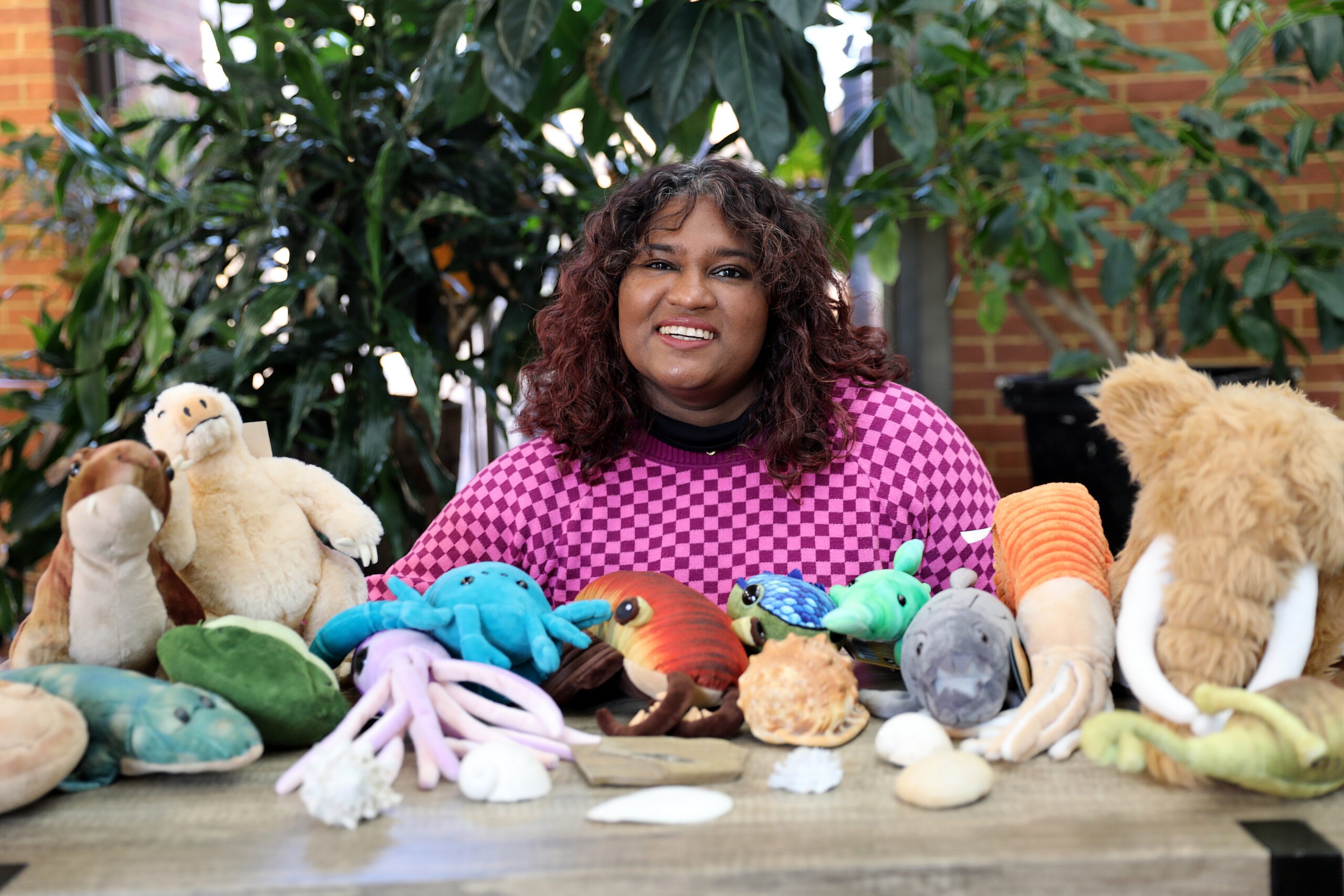
Shamindri Tennakoon has a knack for bringing cold, hard fossils to life—sometimes with the help of a few plush friends.
Tennakoon, who joined the Odum School of Ecology faculty as a lecturer in fall 2025, uses a collection of unusual stuffed animals to take students’ imaginations to a time when squid-like creatures with hard shells—called ammonites—abounded in the seas.
“I am a paleoecologist with a background in zoology, and I love to teach courses that bridge my expertise and experience,” Tennakoon said. In addition to an overview ecology course (ECOL 3500), Tennakoon is teaching Biology and Conservation of Marine Mammals, Ichthyology, and Professional Development for Careers in Ecology.

As an invertebrate paleontologist, Tennakoon studied fossil mollusks and sand dollars or echinoids—sometimes collecting fossils from the field and other times working with museum collections—to piece together a picture of their habitat millions of years ago.
Seeing how the composition of fossils changes over time creates a picture of how the environment itself changed, revealing climate shifts and how some species thrive, while others recede.
Her collection of plush animals helps.
“I took Tiktaalik to my ichthyology class, because it’s a transitional fossil between fishes and tetrapods, like amphibians,” she said. Around 375 million years ago, Tiktaalik, which was first discovered in 2004 off the coast of Greenland, was a fish with large, lobed front fins that probably allowed it to drag its body around on land. Fossils show the 6-foot-long fish also had a neck strong enough to crane his head outside of the water as he searched for prey. In Tennakoon’s class, Tiktaalik is a huggable stuffed toy, as well as a cold, ancient link between swimming and walking animals.
“I also use fossil specimens and videos showing their reconstructions to accompany some of the lectures, which definitely helps students summarize what we’ve talked about in the lecture and see things in their mind’s eye. It’s a visually engaging way to learn,” she said.
Growing up in Sri Lanka, Tennakoon took an interest in ecosystems and how organisms adapt to their surroundings. The South Asian country is a hotspot for biodiversity, and that richness wasn’t lost on Tennakoon as a young girl.
“I was always curious about the world around me. Sri Lanka offers a lot of natural biodiversity, but I also was just that kid who watches lots of documentaries,” she said. “That’s how I became interested in fossils. I’ve always been interested in evolution and the history of life and how animals have evolved to be what they are over so many generations.”
As an undergraduate student studying zoology in Sri Lanka, Tennakoon had the opportunity to do fieldwork that solidified her interest in fossils.
“There was a professor who was an evolutionary biologist working with amphibians who was also interested in paleontology. He had access to a fossil site and was excited to mentor students in a broad range of disciplines,” she said.

That Miocene fossil bed showed her the potential in paleobiology.
Her doctoral studies brought Tennakoon to Florida, where she worked at the Florida Natural History Museum and with University of Florida professor Michal Kowalewski, who is an invertebrate paleontologist.
“The invertebrate paleontology division at the Florida museum is one of the biggest ones in the country and has a lot of emphasis on Cenozoic mollusks—or the ones from the last 66 million years. Florida is a really great place for marine invertebrates, with a good museum collection and lots of different field sites in the Southeast,” she said.
In her graduate research, she studied the physical similarities and differences in closely related mollusks and sand dollars from millions of years ago. The different traits of those creatures—as well the damage left behind when predators attacked them—shows which species were surging at a given time.
Coming to the U.S. from a very different educational system, Tennakoon had to feel her way through. She uses that life experience in her work as a lecturer.
“I can definitely empathize and understand some of the struggles that students go through, not only international students, but students who are coming from different backgrounds,” she said. “Working with students who come from underrepresented backgrounds, I focus on what I can do to help them reach their goals by being part of their mentoring network.”
She also likes to develop accessible field experiences for students, an interest she leaned into while teaching ecology and paleontology at Hendrix College in Arkansas from 2022 to 2025.
“Ultimately, I’m here for the students,” Tennakoon said. “I approach those relationships with empathy and do my best to stay aware of people with different expertise and resources that I can share with the students.”