


Upcoming Events
UGA Coastal Ecology & Resilience Workshop
Thursday, March 5
9 a.m. to 2 p.m.
Dean Rusk Hall, Larry Walker Room
This full-day workshop brings together scholars, practitioners, policymakers and community partners to explore how land-use change and climate change are shaping Georgia’s coastal ecosystems and communities. The morning features two interdisciplinary panels that integrate science, policy and humanities perspectives, followed by open discussion and audience questions. In the afternoon, participants move into facilitated lunch table conversations focused on practical challenges, lived experience, equity, education and community resilience. The event concludes with shared reflections and takeaways, emphasizing collaboration, dialogue and actionable pathways to support a more resilient and inclusive coastal future.
UGA Partners: Department of Geography, School of Law, Willson Center for Humanities and Arts, Georgia Sea Grant and Marine Extension
UGA Planning Partner: Department of Marine Sciences
Sponsors: Georgia Power Company, Rowen Foundation
ODUM SCHOOL COASTAL ECOLOGY AND RESILIENCE INITIATIVE
Georgia’s 100-mile coastline supports profound ecological, economic and cultural benefits. From commercial fisheries to local heritage, from salt marshes to endangered species, Georgia’s coastline is a national treasure with impacts that extend far beyond its shores. Our state’s barrier islands and salt marshes protect communities from storm surges and extreme weather events while supporting livelihoods and industries. Yet, as Georgia’s population and economy continue to grow, so do the pressures on our coastal ecosystems. Through restoration, conservation and sustainable development, the Odum School of Ecology is committed to advancing balanced human development and promoting ecological resilience along our coastline for generations to come.
The Odum School’s Coastal Ecology and Resilience Initiative invites public and private partners to join us in our pursuit of an ecologically, economically and socially resilient coastal region. The initiative aims to leverage UGA’s existing presence on the coast, recruit top-tier ecological talent to our state and remove financial barriers to immersive learning on the coast.
ACADEMIC PARTNERS
Building on UGA’s history as a land-grant institution and the Odum School of Ecology’s origins in coastal and marine ecology, we collaborate with experts across the university in science, engineering, humanities, law and public service. The Odum School of Ecology’s internal partnerships in coastal ecology and resilience include:
- Department of Geography
- Institute for Resilient Infrastructure Systems
- Marine Extension and Georgia Sea Grant
- Marine Institute on Sapelo Island
- Carl Vinson Institute of Government
- River Basin Center
- School of Law
- Skidaway Institute of Oceanography
- Willson Center for Humanities and Arts
PERMANENT PROTECTION FOR A CHANGING COAST
The Odum School’s Coastal Ecology and Resilience Initiative seeks $2 million to seed a sustained funding source to ensure that coastal Georgia can thrive through environmental change. Financial stability is essential to building lasting teaching, research and service programs that promote long-term community resilience. This funding goal will support five undergraduate scholarships, two graduate fellowships, one professorship and one public service fellowship annually.

TRAIN THE NEXT GENERATION
Research fellowships, assistantships and internships train students through immersive learning. Scholarships remove barriers to these experiences so the next generation of leaders can continue to steward Georgia’s coastal region.

CONSERVE & RESTORE ECOSYSTEMS
Faculty support and research grants for innovation in conservation and restoration allow UGA experts to integrate ecological science with
sustainable development. These solutions will benefit Georgia’s consumers, business owners and unique ecosystems.
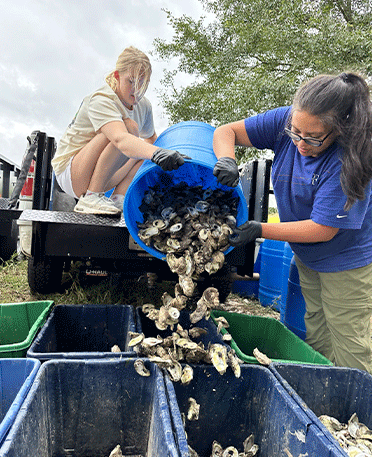
INSPIRE RESILIENT COMMUNITIES
Symposia, workshops and public service projects connect leaders and build relationships. Together, universities, businesses and communities can expand opportunities for Georgians to embrace an ecologically resilient coast.
COASTAL ECOLOGY AND RESILIENCE NEWS
-
Q&A with Jeb Byers: Mapping invasive species along global coastlines
UGA’s Office of Research conducted a Q&A with Ecology’s Jeb Byers.
-
What it takes to create a successful oyster reef breakwater
Jeb Byers, Meigs Distinguished Teaching Professor of Ecology, recently coauthored a publication on oyster reef breakwaters, a form of natural infrastructure.
-
Inside Georgia’s oyster disease epidemic
Researchers at the Odum School of Ecology are studying oyster disease in Georgia.
-
Ecosystem Engineers: Byers studies how marine organisms structure habitat
From beavers, which stop up flowing water to create the pools of water they depend upon, to oysters, which filter seawater and stabilize the shoreline to create more habitat, organisms