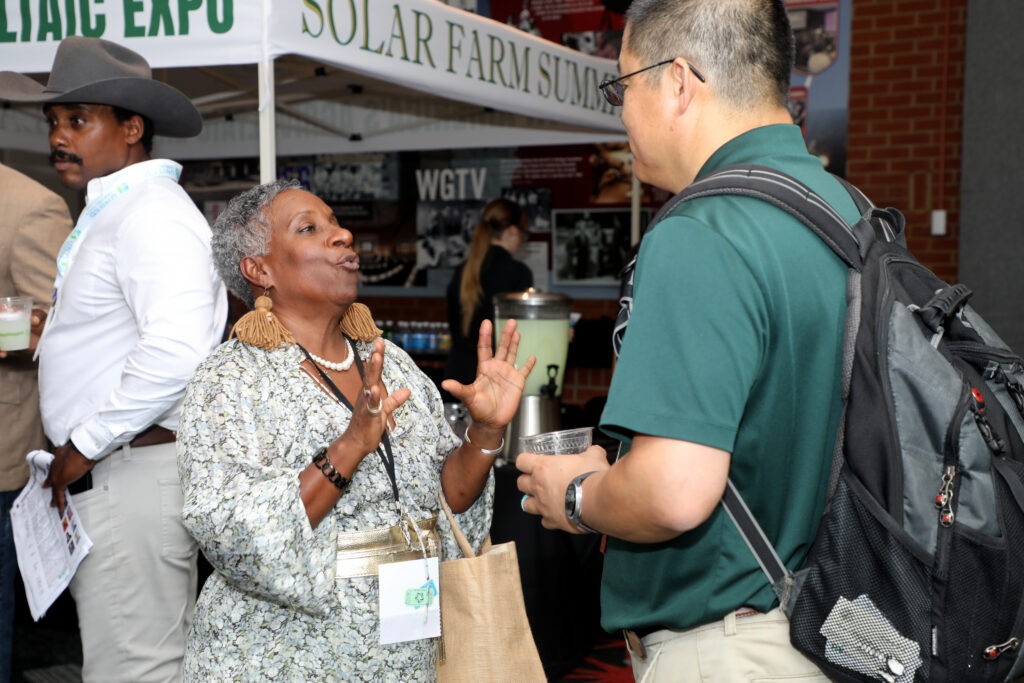
The University of Georgia convened the inaugural Georgia Solar Farm Summit in July, partnering with non-profit Solar Farm Summit to host more than 200 attendees who gathered to discuss solar energy, economic development and land stewardship. The interdisciplinary group included academic researchers, energy producers, farmers, ranchers, businesspeople, community organizers and policymakers from 100-plus organizations.
“Our goal here is the same,” said Mark D. Hunter, Dean and Odum Chair in Ecology, during the opening session. “Farmers get paid. Food gets grown. Power gets generated and transmitted. Communities are supported while we sustain and conserve the precious ecosystems upon which all life and energy depend.”
More than two dozen sessions over two days covered a wide variety of topics including solar grazing, agrivoltaics, solar and conservation best practices, ecovoltaics, solar policy, and solar soil conservation.
Hunter kicked off the Odum School’s session on “UGA’s AgPV Research: Interdisciplinary Students for a Better Energy Future” by describing the university’s VIPR (Vertically Integrated Project Research) model that incorporates students into research programs. It’s an expression of the university’s role as a land-grant institution, according to Hunter.
“The kind of work that students are doing has to be relevant to the people of the state of Georgia,” he said.
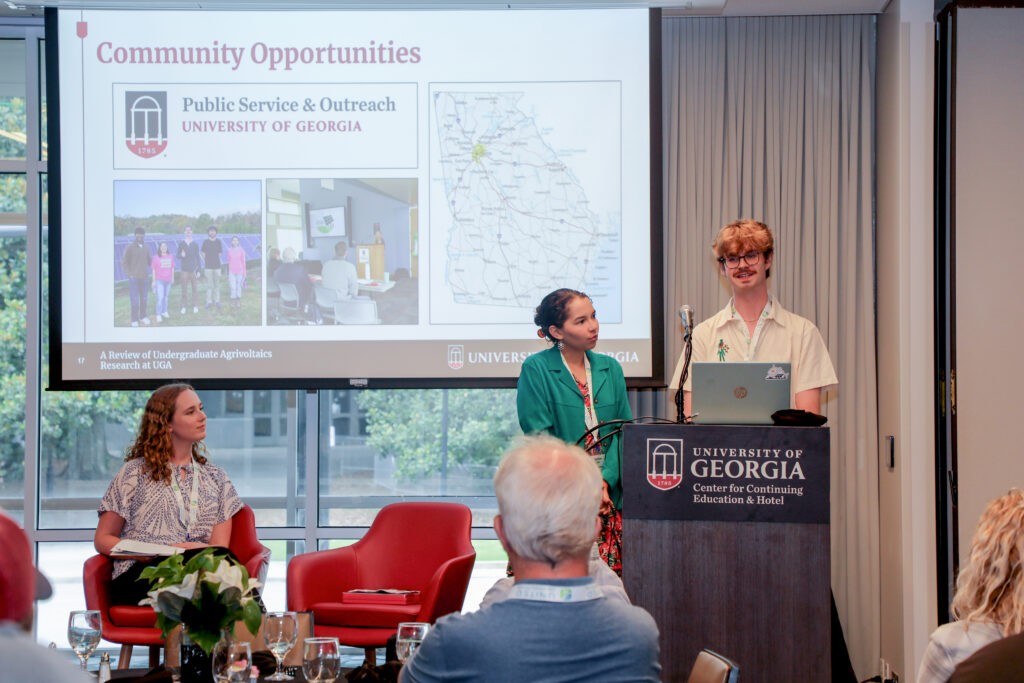
“We go from an idea—a student-generated idea—thorough the development of that idea and ultimately, through our community partnerships, into to the application of that idea.”
The program targets sophomores so that students stay with the program during the rest of their undergrad years and, in some cases, into grad school as well. Three students from the program shared their experiences.
Jacob Coleman, who graduated with degrees in ecology and sociology, is now earning a graduate degree in public administration. His work with the VIPR project focused on identifying socially sustainable pathways for agrivoltaics adoption in Georgia, with an emphasis on ensuring equity and maximizing participation.
Kariana Colon graduated with degrees in ecology and entomology and is now earning a graduate degree in entomology. She spoke about exploring the potential for agrivoltaics systems to support arthropod-mediated ecosystem services like pollination, biological control (using natural predators to control pest populations), nutrient cycling and decomposition, and cultural services like green spaces in urban environments.
Senior Melanie Frick, who was recently named a Udall Scholar, discussed her research on how a perennial legume performs under solar panels.
The program emphasizes a collaborative, interdisciplinary approach, Hunter said.
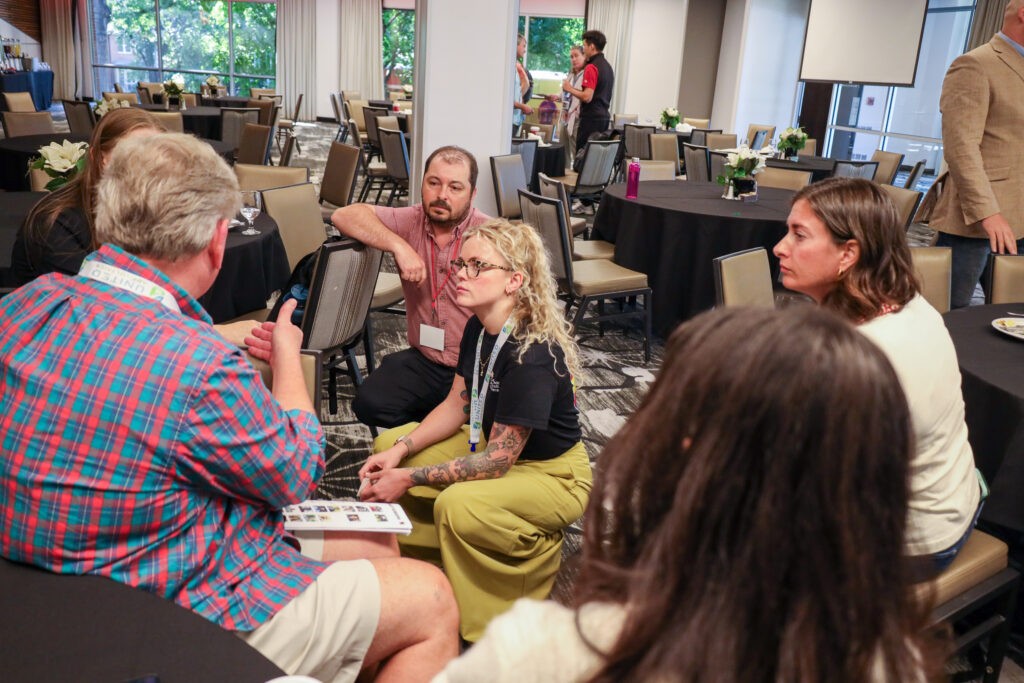
“These are not simple problems with simple solutions. We need students from across multiple schools and colleges who have an interest in applying their work to real-world problems for this to work,” he said, adding that the program attracts stellar students.
“These are the kids who want to change the world, and that’s fantastic. They’re just naturally drawn to these kinds of community-based, society-challenging situations. And we get to harness that enthusiasm.”
In return, the students learn the value of collaboration—how to talk to community members about what they need, and how to take a project and work with people from different skill sets and get something done. It delivers read-world, scalable solutions to complex problems.
“That’s fundamentally what we do here,” Hunter said.
At the Summit’s closing Town Hall Forum, Solar Farm Summit’s Dan French expressed optimism about the future of solar.
“I think we’ve broken through the marketplace of ideas,” he said. “The smart money, the creative money, is starting to see maybe the long-term value of these things. What will be the future value of healthy soils? Where will policy land with respect to organic matter in the soil? I do see the dam breaking.”
He also praised the Odum School and the University of Georgia.
“We wouldn’t have come here without you,” he said. “Your progress, your success, your leadership is one of the reasons we came here, and it’s been so thrilling.”
Hunter issued a challenge.
“You want to see something happen under solar? Give each of [head of horticulture Leo Lombardini’s] students one strip of panels and say, ‘Produce something remarkable over the next two semesters.’ Have a competition and see who can make the most money under a strip of panels. You’ll see exceptionally bright minds doing innovative things that we then can take and make a real difference in the world.”
He also called on attendees to continue collaborating.
“There’s no one group that can do this without everybody else in the room,” he said. “Our success will depend on how well we talk to each other, how well we interact with each other. I would just encourage us all to find opportunities like this where we can come together.”