


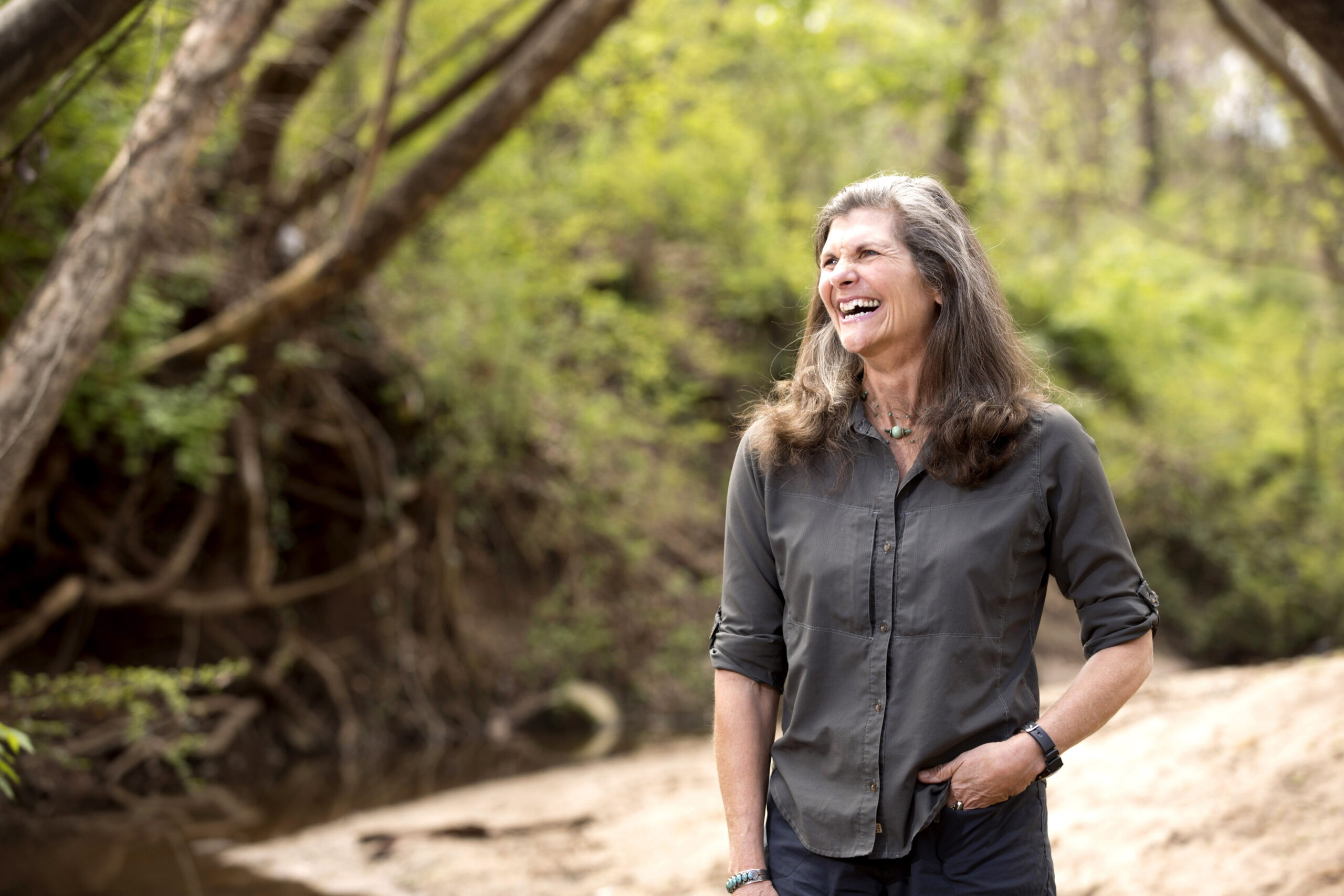
One of the most impactful papers of her career might never have been published if a colleague hadn’t pushed Amy Rosemond to be persistent.
Years of research into small streams in North Carolina had started to show a disturbing picture: Excess nutrients in streams—pollution that comes from land development and agricultural runoff—was causing streams to lose the carbon from decaying leaves and sticks, an important component of the food web. That finding, supported by a model created by Rosemond and her team, meant that polluted streams could quickly lose the ability to support fish and other aquatic life.
“I felt like this information needed to be out there, so we shot for Science because it was a very policy-relevant finding,” Rosemond said. “We worked hard on the paper, wrote a cover letter, sent it off … and got rejected.”
Science is one of the most prestigious publications in the world, but Rosemond knew if the journal reviewed the paper, her peers would see the important breakthrough in her data.
“I went to talk to (fellow Odum School professor) Sonia Altizer and just slumped down in the chair in her office. I explained what happened, and she was so positive and helpful.”
“She said, ‘Did you really make the case to the editor? Did you really say why this is important?’”
Altizer encouraged Rosemond to write the editor and appeal the rejection. It worked.
AN ACCOMPLISHED CAREER
Rosemond officially retired as a professor at the Odum School of Ecology on July 1, and she has since been granted emeritus status. Throughout her career, she studied the effects of land use and climate change on the health of streams, uncovering important lessons about how excess nutrients and other pollutants harm natural ecosystems.
A UGA Foundation Professor in Ecology and Distinguished Research Professor, Rosemond was elected a Fellow of the Ecological Society of America in 2018 for research on the food web, microbial, and biogeochemical dynamics of aquatic ecosystems and received UGA’s Creative Research Medal in Natural Sciences and Engineering that same year.
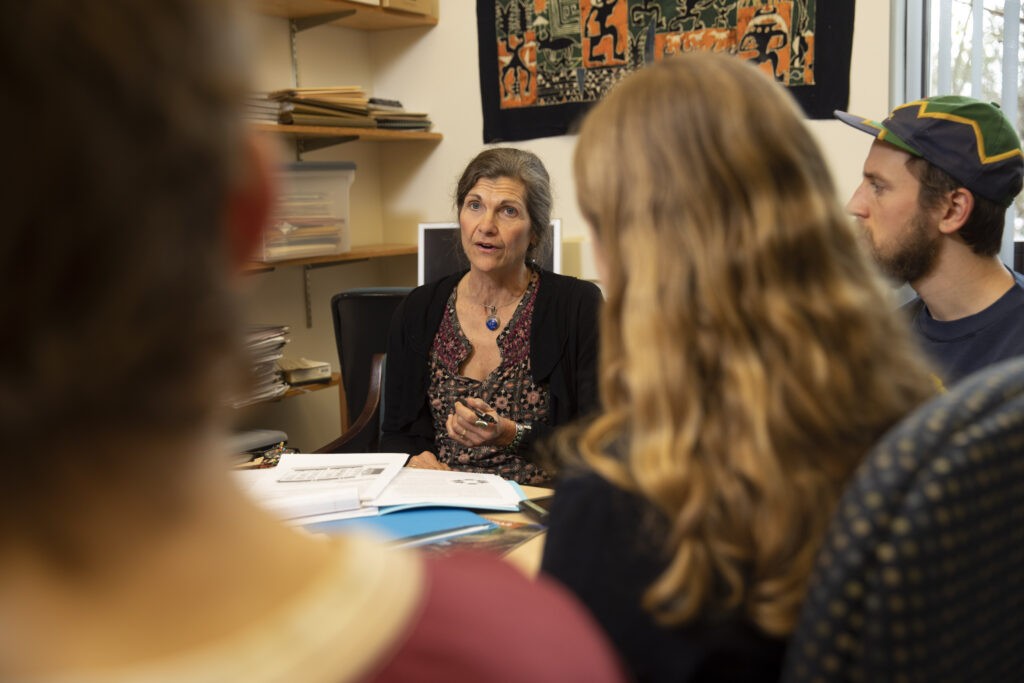
From 1998-2005, she also served as assistant director of the Institute of Ecology, providing key administrative support as the Institute moved toward becoming a stand-alone school in 2007. Alan Covich joined as director in 2001 and worked with Rosemond as a colleague for two decades.
“Amy and I had a good partnership for the years that I was director, and even co-taught an aquatics ecology course,” Covich said. “Amy had the capacity to do everything well—from attracting and nurturing grad students to publishing to maintaining a great teaching record.
“But she also has very strong commitment to ecology at UGA. Not everybody is going to take time to work in administration. But this was an essential time for the Institute of Ecology.”
TEACHING & RESEARCH
Rosemond came to UGA in 1994 as a postdoc. She had secured a National Science Foundation fellowship to work with aquatic ecosystem ecologists Cathy Pringle and Judy Meyer on a project studying nutrients in streams in Costa Rica.
Placing bags of leaves in multiple Costa Rican rivers with different concentrations of phosphorus, they chronicled how much quicker the leaves decomposed in water with more nutrients.
“This was one of the first contributions to knowing that nutrients don’t just stimulate algae in aquatic environments. They stimulate these decomposers and result in less organic matter,” Rosemond said.
Most people are generally aware that nitrogen and phosphorus pollution can lead to algal blooms that harm fish and other wildlife. But Rosemond showed how excess nitrogen and phosphorus deliver a second blow to healthy ecosystems by turbocharging decomposition to break down leaf litter and woody debris. Stream food webs depend on this forest-derived carbon and when it is gone, the whole ecosystem is compromised.
The Costa Rica findings led her to test these concepts at a larger scale. With NSF funding, researchers added nutrients to streams at Coweeta Hydrological Laboratory, a U.S. Forest Service facility in North Carolina.
Rosemond and her collaborators dosed streams with nutrients at concentrations similar to small-scale land disturbance and measured microorganisms’ response. A first experiment ran for seven years in two streams, and a second for three years in five streams, with different combinations of nitrogen and phosphorus to mimic the effects of different land uses.
She found that the additional nutrients reduced forest-derived carbon by half.
“We were frankly shocked at how quickly leaves disappeared when we added nutrients,” Rosemond said. “By summer, the streams looked unnaturally bare.”
She also contributed to a multi-investigator project at the headwaters of the Etowah River that found a threshold for urbanization. Surveying 30 tributaries leading to the Etowah, researchers found that areas with more than 15% urban land use started to see a decline in the sensitive bugs that live only in clean streams. This work helped to define indicators of risk for biotic integrity in streams.
“Dr. Rosemond has an uncanny ability to make the invisible work of freshwater ecosystems more visible, whether that’s an ecosystem-scale process, the importance of freshwaters more broadly, or unrepresented voices in science,” said David Manning (PhD ’15), who conducted his doctoral research under Rosemond and now is an assistant professor at the University of Nebraska at Omaha.
COLLABORATIVE LEADERSHIP
In 2019 and 2020 Rosemond headed the Society for Freshwater Science, an important role in any year, but especially challenging when the COVID-19 pandemic forced meetings online.
During that time, she also established the NSF-funded Emerge program, which sought to get more young scholars from across the U.S. into a network of freshwater scientists. Over five years, 131 young scientists participated in the program, helping them solidify careers that will address some of humanity’s most pressing freshwater issues.
Over the years, she found mentoring through co-piloting was useful.

“There are things that need to get done in a project, products that must be created, but you start with a plan and it’s a shared experience,” she said. “Maybe some of my superpowers are seeing people’s potential and challenging them to reach it. I have tried to keep the big picture of helping students achieve their dreams while also recognizing their need to fly on their own.”
The inspiration worked both ways, she said.
In 2017, when a solar eclipse passed through North Georgia, Rosemond took her students and some kayaks to Lake Hartwell to see totality from a unique perspective.
During the two minutes of darkness, they submerged a dissolved oxygen probe to see if photosynthesis by phytoplankton in the lake shut down when it got dark.
“It reminds me how lucky I am to work with young people and experience the joys of living and learning together,” she told UGA Today a few years later.
Phillip Bumpers worked with Rosemond as a graduate student and contributed to the long-term nutrient addition experiments.
“It was fun being a part of such a large, ambitious project that involved lots of collaborators from different universities,” said Bumpers, who worked as a research professional in the lab and now is an assistant research scientist at the Odum School.
“Dr. Rosemond helped the team to see the end, to think about interpretating the data and their significance, then frame it well for publishing,” he said.
HOPE FOR THE FUTURE
During her career at UGA, Rosemond advised more than 20 graduate students and produced over 100 peer-reviewed publications from research funded by the NSF, U.S. Environmental Protection Agency, U.S. Department of Defense, Georgia Water Resources Institute, and other agencies.
“Dr. Rosemond’s work as a teacher, researcher and administrator have left a profound mark on the Odum School of Ecology. Her groundbreaking research has changed the way that ecologists think about stream ecosystems, and her impact on student mentees will ensure a vibrant legacy for generations to come” said Dean Mark Hunter, Odum Chair in Ecology. “At the same time, her commitment to our community—to the Institute of Ecology and then the Odum School of Ecology—have helped to shape our future contributions in ecological science. It’s hard to overstate her impact.”
Headed into retirement, Rosemond is hopeful that leaders will have the vision for establishing and enforcing policies that will promote healthy functioning freshwater ecosystems.
“We already have tools for providing protection and sustainability of our freshwater ecosystems, but are not using them to their fullest capacity,” she said. “People value clean water and healthy ecosystems. Those values need to be better translated into long-term management that protects aquatic life and water quality. That will require good management of watershed land cover and riparian vegetation, better use of natural infrastructure, and frankly, greater restrictions on where and how much land can be developed.
“Hope for the future depends on actions we take today.”
